Labradorite (Indradhanushi Feldspar)
The storm-grey feldspar that flashes peacock blue and gold, a modern ally for Ketu's inward, intuitive pull.
- Planet
- Ketu (Ketu (South Node))
- Chakra
- Third Eye, Throat
- Element
- Ether
- Hardness
- Mohs 6 - 6.5
- Day
- Saturday
- Finger
- Middle finger of the working hand, or worn as a pendant near the heart
- Metal
- Silver or panchdhatu
- Price
- ₹400 - ₹3,500 for tumbled stones and bracelets; ₹2,000 - ₹15,000 for fine spectrolite pendants
Labradorite looks almost ordinary until you tilt it. Then a sheet of electric blue, teal, gold or even violet sweeps across the surface, an optical effect called labradorescence. It happens because light bounces between microscopically thin layers inside the feldspar, so the colour lives inside the stone rather than on it. First described from Labrador, Canada, fine material now also comes from Madagascar and Finland, where the most colourful variety is traded as spectrolite.
In crystal-healing tradition, labradorite is known as a stone of thresholds: something you keep close when you are between chapters, learning to trust your own instincts, or trying to protect your energy in crowded, demanding spaces. That idea of hidden light behind a quiet exterior is why many astrologers who work with modern crystals connect it to Ketu, the shadow graha of detachment, insight and past-life memory.
It is not a classical Jyotish gem, so we present it honestly as a supportive healing crystal rather than a replacement for cat's eye. Worn as a pendant, bracelet or palm stone, it is a gentle, affordable way to work with Ketu themes such as meditation, intuition and letting go, and its shifting flash makes it one of the most beautiful stones you can own.
Benefits of Labradorite
- Traditionally believed to sharpen intuition and trust in one's inner voice
- Kept by meditators as a focus stone for introspection and quiet reflection
- Believed in crystal lore to act as an energetic shield in crowded or draining places
- Associated with navigating transitions, endings and fresh starts with more calm
- Used to support creative thinking and seeing a problem from a new angle
- Linked in modern practice with softening Ketu-related restlessness and confusion
Labradorite in Vedic astrology
Labradorite does not appear in classical texts such as the Garuda Purana or Brihat Samhita, which name cat's eye (Lehsunia) as Ketu's gem. Contemporary Jyotish practitioners who use healing crystals associate it with Ketu because of its chatoyant-like flash, its link with the unseen and its reputation for spiritual insight. Ketu is the south lunar node, a headless graha of moksha, detachment and past-life karma. Where a cat's eye is considered too strong or too costly, some astrologers suggest labradorite as a gentle, low-intensity support for meditation and inner work, never as an equal to the navaratna.
✓ Who should wear Labradorite
- People running Ketu mahadasha or antardasha who want gentle spiritual support
- Those with Ketu placed in the 8th or 12th house drawn to meditation and research
- Healers, counsellors and creatives who feel easily drained by others
- Anyone going through a major life transition who wants a grounding reminder
- People for whom cat's eye has been judged too intense by their astrologer
✕ Who should avoid it
- Those already feeling detached, spaced-out or withdrawn may prefer a grounding stone first
- People with a heavily afflicted Ketu should consult an astrologer before combining it with cat's eye
- Anyone expecting it to replace a prescribed navaratna should seek personal advice
Is Labradorite right for your Lagna?
In Jyotish a stone's suitability depends on which houses its planet (Ketu) rules for your Ascendant. Tap your Lagna for the full reasoning.
Indradhanushi Feldspar kaun pahne? (Labradorite kisko pehenna chahiye)
Indradhanushi Feldspar Ketu (Ketu (South Node)) ka ratna hai. Rahu-Ketu ka phal Lagna se nahi, kundli mein unki sthiti aur Dasha se dekha jata hai, isliye ise pehenne se pehle kisi yogya jyotishi se kundli dikhana zaroori hai.
How to wear Labradorite
| Finger | Middle finger of the working hand, or worn as a pendant near the heart |
|---|---|
| Metal | Silver or panchdhatu |
| Day | Saturday |
| Time | Early morning after bathing, ideally during Brahma muhurta or sunrise |
| Weight / form | A 20-40 carat pendant, a 8-10 mm bead bracelet, or a palm stone for meditation |
| Beej mantra | Om Straam Streem Straum Sah Ketave Namah (108×) |
How to cleanse & charge Labradorite
- A quick rinse under lukewarm running water, then pat completely dry
- Smudging with sandalwood incense or sage smoke
- Resting it overnight on a selenite plate or clear quartz cluster
- Sound cleansing with a singing bowl or bell
Avoid: Long soaking, which can work into cleavage planes; Salt and harsh chemicals that dull the polish; Hard knocks, as feldspar can split along its cleavage.
Best dates to charge: the next Purnima — see the live moon cleansing calendar.
Where to place Labradorite as per Vastu
Direction: North-West, North-East · Rooms: Meditation Corner, Study, Bedroom
Place a polished labradorite palm stone in the north-west corner of your meditation space and hold it for a few minutes before each sitting.
How to check if Labradorite is real
Fakes are usually iridescent-coated glass, synthetic opalite or resin, and occasionally plain grey feldspar sold as 'rainbow' labradorite with no real flash.
Take the interactive real vs fake crystal test to get an authenticity score.
Labradorite price
Typical price in India: ₹400 - ₹3,500 for tumbled stones and bracelets; ₹2,000 - ₹15,000 for fine spectrolite pendants. International: $8 - $60 for tumbled stones and bracelets; $40 - $250 for high-flash pieces. Price depends on origin, clarity, colour, size and treatment.
Shop Labradorite
 53% OFF
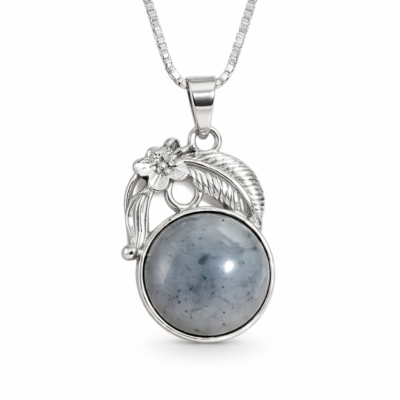 54% OFF
Namaveda is our own store — natural stones, cleansed and energised before dispatch.
Labradorite FAQs
Is labradorite a substitute for cat's eye in Vedic astrology?+
Not in the classical sense. Cat's eye (Lehsunia) is Ketu's traditional navaratna. Labradorite is a modern healing crystal that some astrologers associate with Ketu for its introspective, intuitive qualities. It is traditionally considered much gentler, so it may suit people who want Ketu-themed support without the intensity or cost of a cat's eye. Always ask your astrologer before treating it as a remedy.
Can I wear labradorite every day?+
Yes, with some care. At 6 to 6.5 on the Mohs scale it handles daily wear, but it has cleavage planes that can split with a hard knock. Pendants and earrings are safer than rings for active hands. Remove it before gym sessions, gardening or cleaning with chemicals, and store it away from harder stones that could scratch it.
Why does my labradorite look dull?+
Labradorescence depends on angle and lighting. Under diffused ceiling light it can look plain grey. Try a single strong light source, such as a window or phone torch, and tilt the stone slowly. If no colour appears from any angle, the piece may be low grade feldspar, or it may simply be cut with the flash plane at the wrong angle.
What is the difference between labradorite and spectrolite?+
Spectrolite is a trade name for labradorite from Finland that shows a full spectrum of colours, including reds, oranges and violets, against a very dark body. Standard labradorite usually shows blue and green with occasional gold. Both are the same mineral, but true spectrolite commands a premium, so ask for origin details when a seller uses the name.
Indradhanushi Feldspar kaun pahne? (Labradorite kisko pehenna chahiye)+
Indradhanushi Feldspar Ketu ka ratna hai; iska phal kundli mein Ketu ki sthiti se dekha jata hai, sirf Lagna se nahi. Pehenne se pehle yogya jyotishi se kundli dikhayein.
Not sure this stone is right for you? Check your birth chart in 10 seconds.